What Wire and Cable Quality Standards Should Mumbai Industries Check Before Buying?
Aditya Nair runs quality assurance at a lift control panel manufacturer in Kanjurmarg. When a large elevator OEM scheduled a vendor audit, one checklist line stood out: “Provide standard references and test evidence for all wires and cables used.” Aditya had invoices and brand names, but no record of which standard each cable met.
Many buyers face the same gap. This guide covers the wire and cable quality standards Mumbai industries should check before buying, how each test works and how to read the paperwork behind it.
Why Are Wire and Cable Quality Standards Important?
A cable rarely fails on installation day. Problems surface months later as overheating joints or cracked insulation inside equipment that has already shipped.
Standards prevent that by fixing measurable limits for conductor resistance, insulation thickness and voltage withstand. They let Aditya compare suppliers on facts instead of brand claims, and they show his OEM customer that every lift panel uses wiring built to a known benchmark.
Which Quality Standards Should Mumbai Industries Check?
The right standard depends on the cable type. For industrial cable quality standards, the common Indian references are:
- IS 694 for PVC insulated cables up to 1100 V, which covers most panel and building wires
- IS 1554 (Part 1) for PVC insulated heavy-duty power cables up to 1100 V
- IS 7098 (Part 1) for XLPE insulated power cables up to 1100 V
- IS 8130 for the conductors used inside insulated cables
- ISO 6722 for automotive single-core cables
Export buyers may also ask for IEC 60228 or IEC 60502-1. Aditya mapped every cable in his panels to one reference. Panel wiring fell under IS 694 and the incoming supply cable under IS 1554.
Why Are Conductor Quality and Material Important?
The conductor carries the current, so its quality decides how much heat and voltage drop the cable produces. Higher resistance means more energy turns into heat, which ages insulation faster and loosens terminations over time.
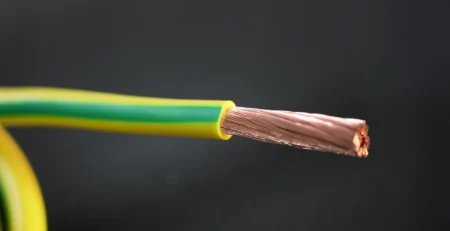
IS 8130 sets the maximum DC resistance for each conductor size at 20°C, along with the stranding class. Class 5 flexible conductors, for example, use fine strands for panel wiring that bends during assembly. Aditya looked for measured resistance below the IS 8130 limit for each size, not a generic claim about pure copper.
How Is Cable Insulation Quality Tested?
Insulation quality depends on both thickness and material, and the IS 10810 series sets out the test methods Indian cable standards rely on. Typical checks include minimum thickness at several points around the core, tensile strength and elongation of the insulation, and behaviour after heat ageing. PVC compounds should also meet IS 5831. For XLPE cables, a hot set test confirms that the insulation has been cured properly.
This wire quality testing mattered to Aditya because lift machine rooms run warm, and insulation that stays flexible after heat ageing is less likely to crack at bends.
Which Electrical Tests Should Industrial Cables Pass?
Electrical tests confirm how a cable behaves under stress. Most cable standards require:
- Conductor resistance test to confirm current-carrying efficiency
- High voltage test to show the insulation withstands a voltage well above its rating without breakdown.
- Insulation resistance test to confirm minimal leakage current
- Spark test during production to detect pinholes or thin spots in the insulation
These cable testing standards separate routine tests, done on every production length, from type tests, done to qualify a design. Aditya asked suppliers for both.
Why Are Cable Certifications Important for Buyers?
Test reports show what a manufacturer measured. Certification shows that an independent body checked the product and the factory controls behind it.
In India, many cable types require BIS certification under the Electrical Wires, Cables, Appliances and Protection Devices and Accessories (Quality Control) Order, 2003. A valid BIS licence lets the manufacturer use the ISI mark for that standard. For exports, buyers may ask for UL or other international approvals.
Cable quality certification answers one question for Aditya’s OEM customer. Did someone outside the factory confirm the product meets the standard? He verified each licence number on the BIS website against the exact standard and sizes he bought.
How Do Test Reports Help Industries Verify Cable Quality?
A good test report names the standard, lists each test with its measured value and permitted limit, and carries the batch or drum number printed on the cable.
Aditya’s stores team now matches the drum number on every delivery with its report before issuing the cable to the shop floor. For wire and cable testing, Mumbai buyers can rely on reports from an NABL accredited laboratory, adding independent weight, especially for type tests.
What Should Mumbai Industries Check Before Purchasing Cables?
Before placing an order, run through a short checklist:
- The cable’s printed marking shows the standard, size, and voltage grade.
- A valid BIS licence covers the exact standard and size where certification applies.
- Routine test reports are available by batch.
- A recent type test report is available for each product.
- Conductor resistance values fall within IS 8130 limits.
- Samples pass your own incoming inspection before bulk supply.
Wire and cable quality testing Mumbai buyers do on receipt needs no expensive lab. A micrometre, a resistance check and a marking review catch most problems.
What Aditya Took Into the Audit Room
Aditya walked into the audit with a cable register that listed every wire, its standard, its BIS license, and its latest test report. The auditor closed the cable section in twenty minutes. Clear electrical wire quality standards and suppliers who backed their products with evidence made that possible. Treat the wire and cable quality standards Mumbai OEMs ask for as part of purchasing, not an audit afterthought.
At Balaji Wires and Cables, we manufacture copper wires, shielded control cables, high-temperature wires, and automotive and battery cables for buyers in Mumbai and beyond. Need standard references or test documents for your next order? Share your requirements with our team, and we will walk you through the options.
https://balajiwires.in | info@balajiwires.in | +91 8976778884
Frequently Asked Questions
What quality standards should Mumbai industries check before buying cables?
The wire and cable quality standards in Mumbai industries depend on the cable type. Common references are IS 694, IS 1554 (Part 1) and IS 7098 (Part 1) for power and building cables, IS 8130 for conductors and ISO 6722 for automotive cables.
How is wire and cable quality tested?
Manufacturers test conductor resistance, insulation thickness, tensile strength, heat ageing, insulation resistance and high voltage withstand, using methods set out in the IS 10810 series.
Why is conductor quality important in cables?
Conductor quality controls resistance. Lower resistance reduces heat, voltage drop, and energy loss, which protects insulation and terminations over the life of the installation.
What certifications should industrial cables have?
Industrial cables should carry BIS certification where the Quality Control Order applies, plus a test report against the relevant industrial cable quality standards. Export buyers may also need UL or other international approvals.
How can businesses verify cable quality before purchasing?
Verify the BIS license online, review batch test reports and type test reports, check the cable marking, and inspect samples for resistance and insulation thickness before bulk orders.